Parts of this article were drafted with the help of AI.
Disclaimer: The content here is my personal opinion and does not represent the collective opinion of any organization.
Field Station Rajasthan: A Sovereign Playground for a Sovereign Stack
Network states, parallel societies, pop-up cities, experimental villages. Whatever you call them, I've now spent time in around eight of these experiments around the world. Each one had its own flavour, but they all put the community first, and for a builder that makes them an unfair advantage.
These places are the perfect environment to turn an idea into a product and find your first ten users. Most early-stage projects die looking for those users, while you're living alongside them, eating with them and sitting next to them during work blocks. Dogfooding and gathering feedback are far easier inside a small, self-organising community that has opted in to trying new things together.
Logos is a technology stack for building parallel societies. Experiments like these are the physical side of that same idea. One gives you the protocols; the other gives you the people, the place and the problems to point them at. I've come to believe neither works as well on its own. Field Station Rajasthan was our attempt to bring the two together.
We hosted Field Station Rajasthan alongside ZuGrama. From more than 150 applications, we invited 24 builders from across India to join the residency.
Why a residency, and why India
Most of the pop-up city movement has so far been concentrated in a handful of places: Europe, the Americas, parts of Southeast Asia. India has one of the largest and fastest-growing developer communities in the world, and plenty of people here are thinking hard about questions of privacy, digital public infrastructure and who controls the systems we depend on. Yet very few of these experiments have actually taken place here.
Rather than run another hackathon, we wanted to bring a small group of builders into a place where they could live the questions, not just talk about them. A residency gives you time, which hackathons never do. Eight days is short, but it's long enough for people to drop their guard, change their minds and build something they didn't arrive planning to build.
The people
In my opinion, 90% of the work behind a successful residency is getting the right people in the room, and that's where Field Station really delivered.
Reviewing more than 150 applications was a lot of work, but it was worth it. We weren't looking for the most impressive CVs. We looked for people with a strong point of view, a real problem they cared about, and the openness to have that problem reshaped by people from completely different fields. The cohort that came out of that process was very diverse: developers, design thinkers, biotechnologists, architects, philosophers and more.
I'll be honest. When I met everyone in person on day one, I was nervous. With only eight days together, I didn't know whether people from such different disciplines would actually click and cross-pollinate ideas, or whether they'd stay in their own lanes.
Demo day showed my worry was misplaced. [Add 2–3 concrete examples here: a project that came out of an unlikely collaboration, a team that formed mid-week, or something that got built on top of Logos.] Seeing an architect and a protocol developer sketch out the same problem from opposite ends is exactly why you put these people in one place.
The lesson I took away is that diversity isn't a nice-to-have for these experiments. It's what makes them work. A room full of protocol engineers will build better protocols. A room full of engineers, biologists, architects and philosophers will ask what the protocol is for, and that's the question that matters most.
The setting
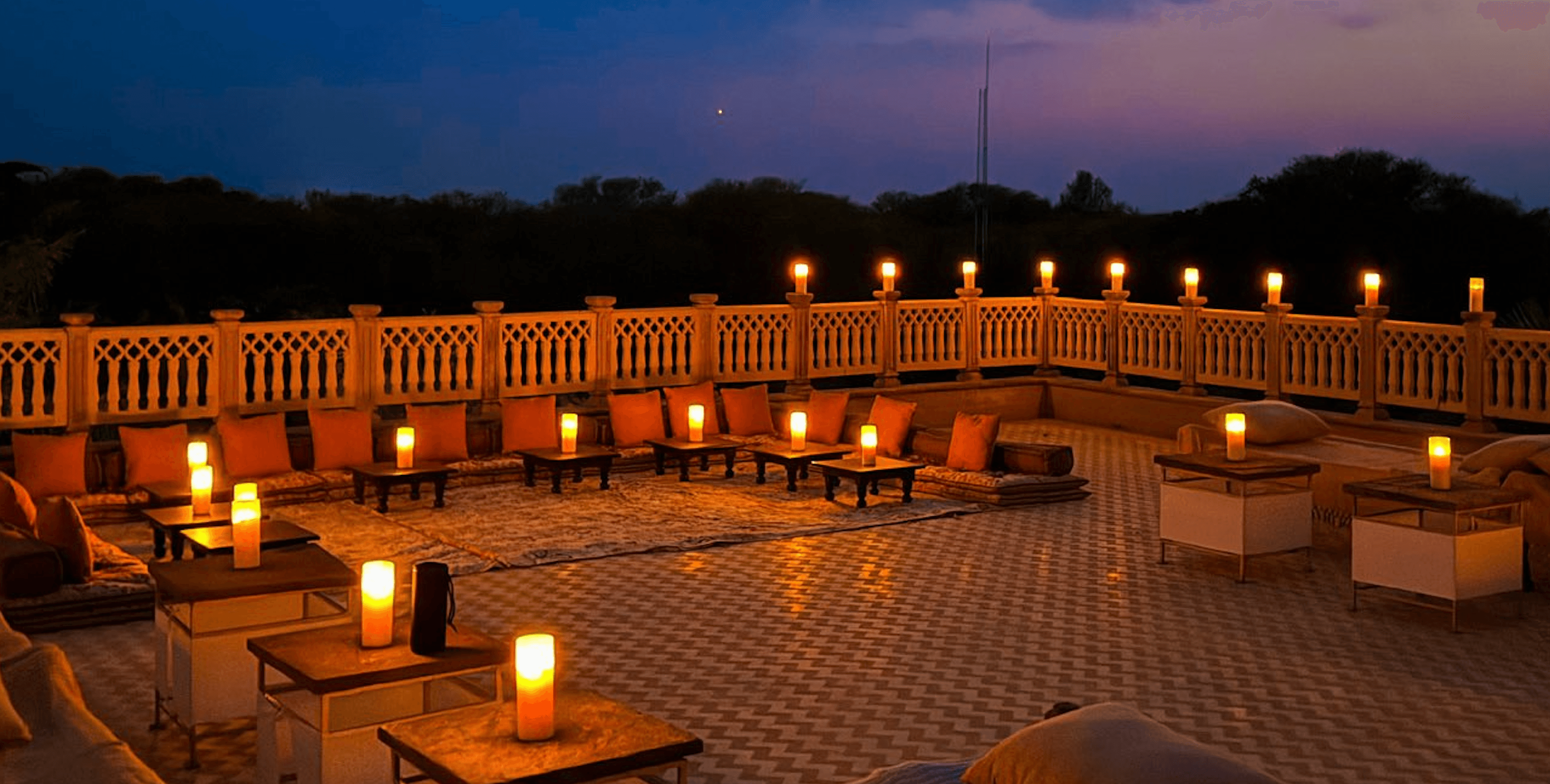
Field Station Rajasthan took place at Dhun, a 500-acre bio-reserve in the middle of the grazing lands of Rajasthan, India. I'm Indian and visited Rajasthan twice as a kid, but this was a completely new and offbeat experience for me.
Dhun is home to a wide variety of non-human species, native flora and hundreds of villagers. There's even a school on the property. What struck me most was the transformation: land that was once dry grazing ground is now a living, habitable landscape with ponds, greenery and a beautiful haveli, where most of our activities took place.
It's hard to overstate how fitting that backdrop was. Dhun is proof that a community, given time and a shared purpose, can rebuild a commons that looked impossible to restore. That's exactly what we're trying to do with digital infrastructure: build public goods that belong to the people who use them, not to whoever owns the servers.
What a usual day looked like
I've been to pop-ups in the Swiss Alps, Patagonia, cities like Istanbul and the old quarter of Chiang Mai. What made Field Station different was its remoteness. The nearest convenience store was an hour away by car. With no easy outs, people had to think and hack their way through everyday problems, which is a good way to find out what actually matters.
Each day started with something active, like a swim in the lake or a horse-riding lesson. As a committed late riser I missed both, so I can't say much about them.
My personal favourite was the daily stand-up, done while holding a plank. Everyone gave their updates and committed to the day's to-dos mid-plank. It was surprisingly effective: nobody rambles when their core is on fire, and saying your goals out loud in front of the whole cohort builds real accountability.
All three meals were farm-to-table, and a protected five-hour work block each day gave everyone real time to focus. Evenings were looser, with long conversations over dinner, impromptu sessions and the kind of cross-pollination you can't schedule.
The agenda was bottom-up, so anyone could run a workshop, talk or session. On day two I ran a workshop on building on top of Logos, which turned out to be one of my favourite moments of the week. Running it so early meant people had the rest of the residency to actually use what they'd learned, and several came back over the following days with questions, ideas and half-built prototypes.
Why physical experiments and the Logos stack need each other
As a developer relations person, I spend most of my time explaining what Logos is. Explaining a protocol is one thing. Watching people need it is something else, and Field Station showed me how much the two complement each other.
Mapping the stack to village life
The simplest way I've found to explain Logos is to map each part of the stack to something any community needs:
- Logos Messaging is how a community talks. Private, peer-to-peer communication with no central server reading, storing or selling your conversations. In a village, that covers everything from coordinating meals to organising around sensitive issues without worrying about who's listening.
- Logos Storage is a community's shared memory. Decentralised storage for the things a community produces together, such as documents, research, records and media, without a single provider who can delete them, lose them or lock them away.
- Logos Blockchain is how a community decides and exchanges value. Coordination, governance and value transfer that doesn't depend on a single institution's permission. Shared treasuries, collective decisions and agreements that everyone can verify.
- Logos Basecamp is how a community actually uses all of it. The application layer that brings the stack together for people who will never read a spec, and shouldn't have to.
On a slide this all sounds abstract. In a village of 24 builders, an hour away from the nearest shop, it stops being abstract very quickly.
Five ways the physical and the digital reinforce each other
1. Physical communities surface real use cases. Protocol designers tend to start from the technology and go looking for a problem. A village works the other way round. When a group of people actually lives together, even for a week, real coordination problems show up quickly: how do we share information, make decisions, manage shared resources and trust each other without a central authority? Those are the problems the Logos stack was built for, and a residency puts them right in front of you.
2. Real-world constraints are the best stress test. A remote bio-reserve doesn't have perfect connectivity, and that's the point. Infrastructure for sovereignty has to work when the network is patchy, when there's no cloud provider to fall back on, and when the people using it aren't engineers. Peer-to-peer messaging and decentralised storage stop being abstract properties and become things you can either rely on or can't. Every rough edge you find in a place like Dhun is one you won't ship to a community that really depends on it.
3. Dogfooding with a community that has opted in. The hardest part of any new protocol is getting the first users. A residency hands you a small, curious, high-trust group who have already chosen to experiment. They'll try your app, break it and tell you exactly why, in person, over dinner. That feedback loop is days long, not months. No survey or analytics dashboard comes close.
4. The workshop becomes a product lab. In a normal DevRel setting, a workshop ends when the session does. At Field Station, people could take what they learned in the morning, build with it in the afternoon and demo it by the end of the week. For me, that's the most honest measure of developer experience: can someone go from "what is this?" to "I shipped something" in a few days? Wherever they couldn't, that's a gap in our docs, tooling or onboarding, and now we know exactly where it is.
5. The stack makes the experiments last. Pop-up cities are temporary by design, and that's both their strength and their weakness. The people go home, but the community, its decisions, its data and its relationships don't have to disappear with them. Logos gives these experiments a way to carry on digitally: private channels on Logos Messaging that persist, shared archives on Logos Storage that nobody owns, and coordination on Logos Blockchain that outlives the event. The physical experiment starts the community, and the stack keeps it going.
What I learned as a DevRel
Field Station changed how I think about my own job.
Demos beat documentation. People didn't get excited about Logos because of an architecture diagram. They got excited when they saw a concrete thing working in a place where it obviously mattered. From now on I want to lead with use cases and stories, and only then go into the protocols.
Non-developers are part of the developer ecosystem. Some of the sharpest questions about privacy and sovereignty came from the architects, biologists and philosophers, not the engineers. They're the ones who'll define what gets built, even if someone else writes the code. Developer relations for a sovereign stack has to make room for them.
Feedback is better in person. Async feedback forms tell you what went wrong. Watching someone struggle through your onboarding over their shoulder tells you why. [Add one specific piece of feedback from the cohort that's shaping what you're working on now.]
Use cases come from lived experience. The best ideas I heard all week didn't come from people asking "what can I build with Logos?" They came from people saying "this is a problem in my community" and then asking whether Logos could help. That's the order we should be encouraging.
Where Logos is going from here
Logos is not for everyone. It isn't for people who are happy to trade their sovereignty or privacy for convenience, and I'll admit I make that trade myself every day. I use Instagram. I use traditional banks. Most of us do, and that's fine.
But there are some areas where I'd never compromise on sovereignty: who can read my private conversations, who controls my identity, who can freeze my ability to transact or organise. Those areas are where Logos matters. Our job isn't to convince everyone to give up convenience. It's to make sure a sovereign alternative exists, works well and is there when people need it.
It takes a village to work out exactly what those use cases are and to build civil infrastructure that protects civil liberties. I see Field Station as a tool for doing that: finding those use cases, building them and dogfooding them with real people. Want to rethink how a community saves, lends or governs itself? Prototype it with a village that actually cares about what you're building, and learn what works before you spend years on the long road to formal approval.
That's the bigger vision for me. Logos builds the infrastructure, places like Field Station test it with real people in real conditions, and what we learn feeds back into the stack. Every residency makes the protocols better, and every improvement to the protocols makes the next experiment more ambitious.
Logos is building a sovereign stack, and a sovereign stack needs a sovereign playground to be tested in. Field Station is that playground. Personally, after my 3 years of building with Logos - i'm fully motivated to drive more Field Stations forward and I hope the other core contributors at Logos feel the same way.
What did people build
We had about 14 projects using Logos in different ways. After a demo day, the following projects were awarded with milestone based grants :
- Bosphorous : A privacy preserving lending/borrowing market highlighting the PriFi capabilities in Logos
- Offline ZCash : Using mesh networks to make offline ZCash transactions possible with Logos Basecamp
- Pukaar : Tooling for network states and parallel societies - a basecamp module for community coordination at popup cities
- Dhun Commons : Using Logos to connect the community at Dhun to the world with emphasis on private data and finance
Getting involved beyond the residency
If you're a developer looking to get started with building on Logos - we have two paths forward at this moment : RFPs and Lambda Prizes. Detailed information about both of these can be found in the Developer programs page. I'm actively looking to support teams that are interested in Logos RFPs - we've contracted over USD 400k+ with multiple teams until now. Please reach out if you're keen to know more.